
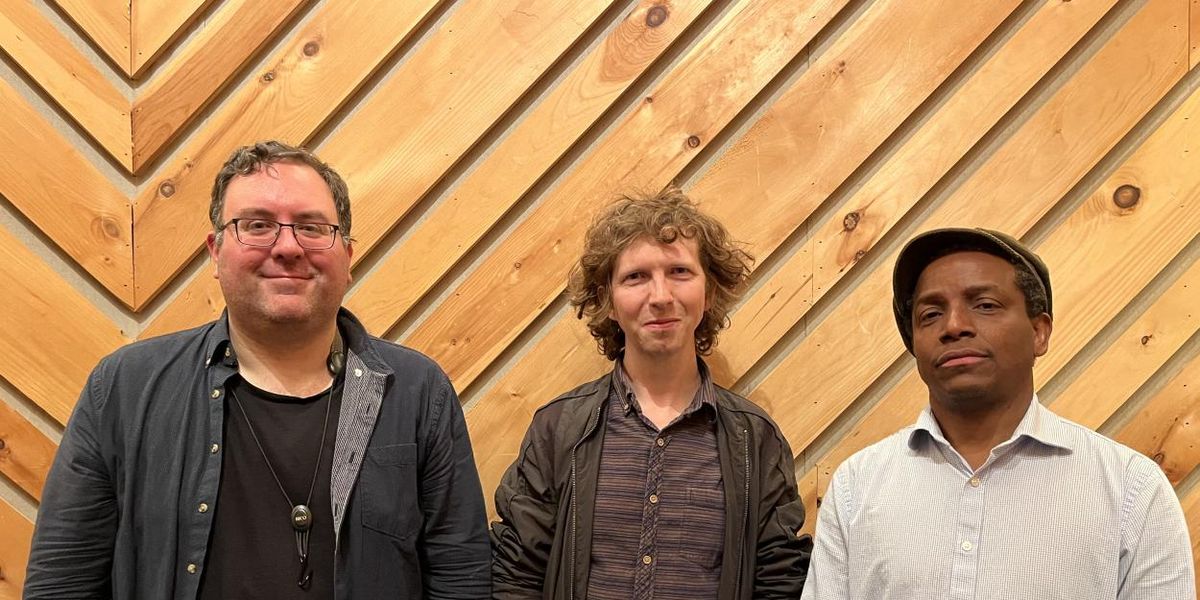
A review of Arrival by Nicki Adams and Michael Eaton, and a brief history of bassless ensembles throughout the jazz canon.
Released on September 10th, 2026, Arrival is the third release by Nicki Adams and Michael Eaton as a duo, and features the addition of renowned drummer Francisco Mela. While the previous records consisted of a piano-saxophone duo, this record adds in the drums to the mix – and in doing so omits a bassist. Making up for the bass is the fourth member of the band – Nicki’s left hand, which more than compensates for the omission.
To fully understand what is happening in Nicki’s left hand, it is important to understand the long lineage of records where bass is replaced by the left hand of a pianist. So before we get into my review of this record, we are going to dive into some of the great bassless records – and analyze how each of these ensembles approaches the instrumentation.
A History of the Bassless Trio
While today it might be unusual to have a record omitting the bass, in the origins of jazz it wasn’t all that strange. Before 1925, the recording technology of the time consisted of recording cylinders that had a hard time picking up the soft and low sounds of the upright bass. Standard solutions included replacing the bass with a tuba, doubling the part of the bass with the tuba, or replacing the bass entirely with stride piano. One example of this is Louis Armstrong’s Hot Five recordings in 1925 featuring his wife “Lil” Armstrong’s left hand taking the role of the bass in the form of stride piano. This record has banjo accentuating the rhythm of the piano with staccato quarter notes, adding to the rhythmic propulsion of the ensemble.
This stride style of piano playing comes directly from the ragtime tradition, which has its roots in European military marches, German polka, and African-American banjo playing. It consists of low bass notes alternating with mid-range chords – quite literally “striding” up and down the piano. There are countless great stride pianists, but some of the most famous examples are James P. Johnson, Willie “The Lion” Smith, Fats Waller, and Art Tatum. A solo stride pianist would fill entire rooms at Harlem rent parties in the 1920s and 1930s, so needless to say, stride piano is powerful enough to substitute for a bassist in an ensemble.
After the proliferation of electric recording in 1925, there were still many records that didn’t use bass. Bix Beiderbecke recorded an octet in 1927 with five horns, guitar, piano, and drums, but no bassist. In this record, the pianist is playing stride while the guitarist plays quarter notes with some low bass notes sprinkled in. The record feels complete, and the piano and guitar nicely complement each other.
From 1935 to 1939, the Benny Goodman trio actively recorded featuring Teddy Wilson on the piano and Gene Krupa on the drums. Teddy Wilson solely plays stride on this record – even at the fastest tempos. This approach is both virtuosic and highly propulsive rhythmically.
The Lester Young Trio recorded a session between March and April 1946 featuring Buddy Rich on drums and Nat King Cole on piano. Nat King Cole plays a combination of stride piano, walking bass lines, and left hand stabs. His walking 10ths are especially remarkable – you can hear them in his left hand while he solos on “Somebody Loves Me”. He is clearly influenced by Teddy Wilson, but his left hand on these recordings is much more dynamic than Teddy’s. This is probably the biggest influence on Arrival – with both Micheal’s smooth tenor sound embodying Lester and Nicki’s dynamic approach to walking and striding in the left hand.
After the 1940s, bassless ensembles became increasingly more rare. The exception to this rule is the organ trio, consisting of guitar, drums, and organ, the organist’s left hand performing the role of the bassist on the Hammond B3. Organist “Wild Bill” Davis was the one of the first organists to popularize this style in 1951, and it picked on quickly. This paved the way for Jimmy McGriff, Shirley Scott, Jimmy Smith, and Larry Young. To this day you can find many great organ trios performing regularly without a bassist. You can also find many contemporary keyboardists performing a synthesizer bass with their left hand in lieu of a bassist, like James Francies, Domi, or Chris Fishman in Pat Metheny’s touring band. The distinction between organ (and synthesizer) and a pianist’s left hand can be remarkable. Pianists can play multiple notes at the same time, and intertwine their hands together in a way that organists cannot.
Moving on to the modern era, I’d be remiss if I didn’t mention the great trio of Joe Lovano, Bill Frissell, and Paul Motian, who made records for decades without a bassist. Their ambient and atmospheric sound is enhanced by their lack of bass. More interestingly, unlike any other ensemble listed, the members are not compensating for lack of bass. Instead, the lack of rhythmic propulsion takes the listener into a trance, soothing the ears whilst the improvisers explore the sonic world they created.
The last ensemble I want to mention is Don Byron’s 2004 trio record Ivey-Divey featuring Jason Moran on piano and the late great Jack DeJohnette on drums. In this record, Moran abandons the traditional bassist’s duties, and plays like a piano player. His comping for his and Byron’s solos is primarily the chord jabs of traditional piano comping, but with rooted voicings instead of the more standard rootless voicings of today’s day and age. This record is an homage to the previously mentioned Lester Young trio, adopting its instrumentation, repertoire, and even its title “Ivey-divey” from a phrase Lester Young used to use meaning to “go with the flow”.
Review of Arrival
Now that we have examined the history of pianists filling the role of bass, let’s examine how Nicki fills this gap with his left hand. What makes Nicki’s playing so compelling is that he combines many of the techniques listed above, and mixes and matches them throughout the record. His playing is really an amalgamation of the whole history of left-handed pianism.
Nicki does a fair amount of walking on this record (“Black Sabbath”, “Solarity”, and “ESP”), simulating a bassist like an organist would play with their left hand. On “It’s Alright with Me” and “Homage” he makes use of stride, simulating the great stride pianists and how Teddy Wilson played on the Benny Goodman records. Parts of “Homage” feel reminiscent of Nat where he breaks freaking free from the low-high back and forth of early stride playing. “Arrival” and “Discursive Formation” consist of broken patterns similar to much of modern classical music, and sometimes he plays as if there is no bassist altogether (“Daily Battles” and “Kupka Discs”), which feels like a sonic breath.
Being the bassist and soloist at the same time gives Nicki certain liberties to embellish the harmony that most soloists don’t have, which makes for some really interesting pedal points and substitutions. Nicki’s playing is at its best when it’s more dynamic and free – when he is being more adventurous with displacements and harmony is when this record really hits its stride. It is in these moments where he really locks in with Mela and they ascend to another plane.
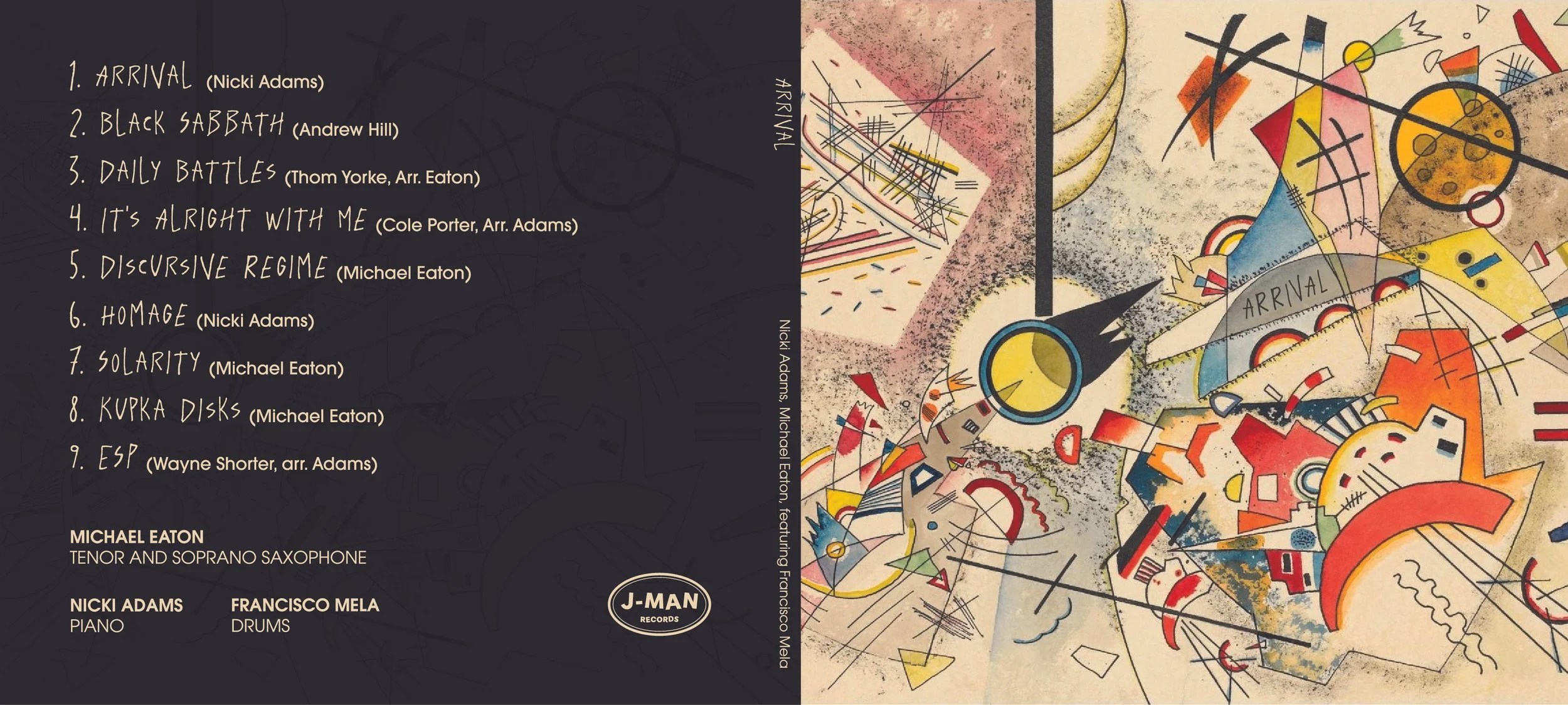
Nicki’s left hand aside, this record is a fantastic session consisting of creative improvisations from everyone involved. “Arrival” – Nicki’s original – and “Black Sabbath” by Andrew Hill start the record strongly in a modal / post-bop vein. Mela’s propulsive drumming drives both songs, which climaxes in an explosive solo on both tracks. Nicki and Michael both take strong solos.
“Daily Battles” – written by Thom Yorke or Radiohead fame – is a nice breather from the hard swing of the previous tracks. Nicki’s left hand arpeggios, Mela’s brushes, and Michael’s breathy tenor create a calming sonic soundscape without losing any of the emotional intensity of the previous tracks.
With “It’s All Right With Me”, a Cole Porter tune, we’re back to the races! The track feels like two worlds in one – on one hand it’s an old Cole Porter composition and features heavy stride piano and sometimes walking 10ths in Nicki’s left hand – on the other hand Mela’s drumming, Eaton’s Coltrane-inspired sheets of sound, and the arrangement and reharmonization of the melody suggest a modern post-bop aesthetic. Somehow these two sonic universes collide to create a sound larger than the sum of its parts.
The melody of Michael’s “Discursive Formation” hints at the avante-garde, and the solo consists of an odd time signature groove which creates a feeling of bursting at the seams. Nicki’s “Homage” is equal parts a straight swinger and a post-bop deconstruction. Nicki primarily plays stride in his left hand on this track, but the chord structures make it feel much more modern. “Solarity” continues the momentum, with a motivic solo from Nicki which features some really nice moments of interaction with Mela.
While “Discursive Formation” hints at the avante garde, “Kupka Discs” dives right in. Michael’s impressionistic soprano playing anchors this track together – it is composed in moments yet free in others. It is the only track on the record where Nicki’s left hand is not a bass player, and features the deepest listening and interaction on the record.
And of course the record’s finale, Nicki’s rearrangement of Wayne Shorter’s “ESP”, unleashes beastly playing from all players involved (Nicki’s left hand included). The track culminates in an epic unison line to bring the record to a close.
The record is a juxtaposition of history – between each player and between each track. Nicki’s piano playing can span early stride and modern classical, and Michael can sound like a breathy Lester Young or Ben Webster, then two measures later have the weight of a modern player like Joe Henderson or John Coltrane.
However, regardless of musical style, each decision feels natural and based on the musical moment. The strong personalities of each player make the record stylistically cohesive, even though each track is wildly different. This is a record that could only be made in this day and age – it is historically informed yet completely present. For these reasons I would highly recommend for anyone reading to listen to this album and to look out for all three of these musicians throughout their careers.

